
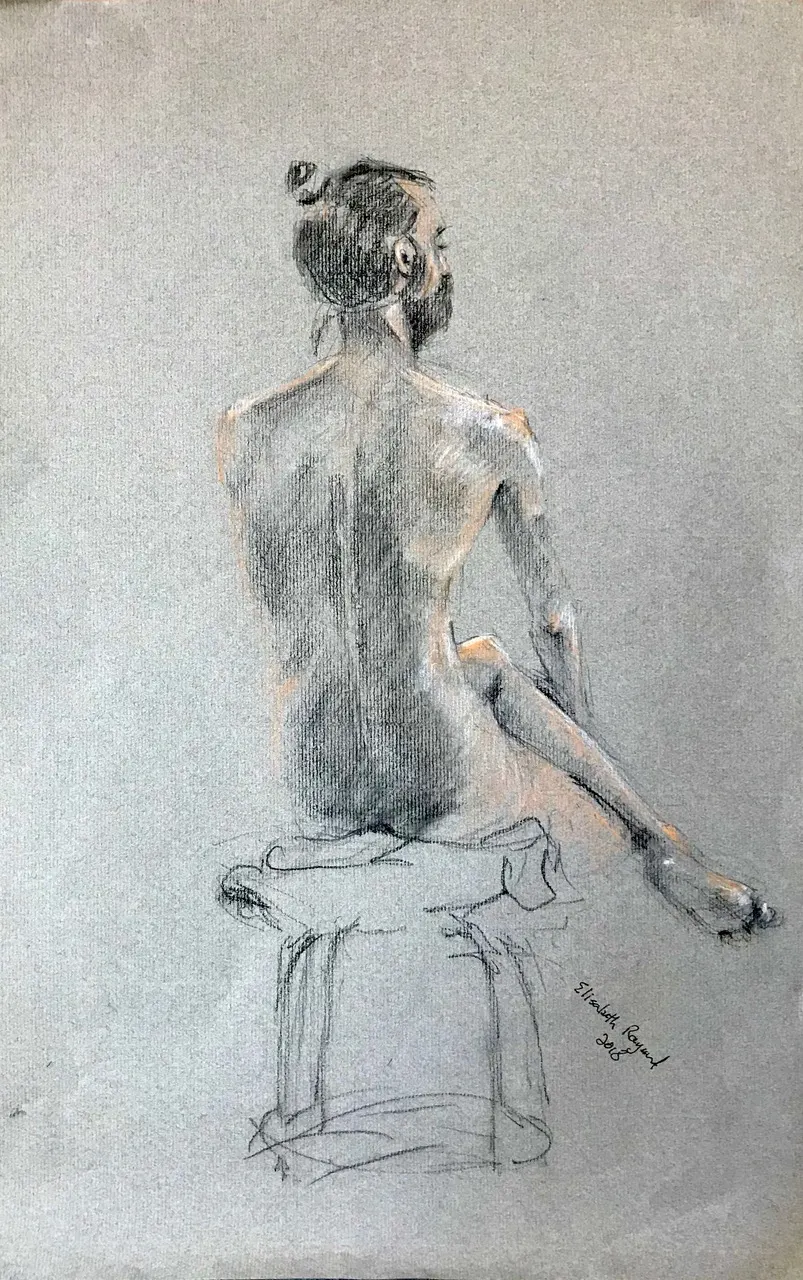
After obtaining an undergraduate degree in visual arts from Concordia University,
Elisabeth worked in the fine arts fields for a few years. However, it was not until 2012 that she started drawing again through various live models workshops. For me, to master drawing is essential in the development of the pictorial work. I like to draw sketches and integrate elements from my imagination as well as from the reality I observe, in order to create an atmosphere. I paint what moves me, what makes me tick and it can be a human body, a flower, a place or an animal. Certain themes particularly appeal to me, such as nature as a whole and our relationship with it. Lastly, I have participated in some exhibitions within the past four years, such as at the gallery 2112 in October 2019 as part of an event of Art and Culture open to the public and also at the gallery «The Artist» in September 2018. Also, I exhibited several paintings in two symposia, one in Quebec “Symposium Plaines Couleurs” and the other in Montreal “Symposium Artisart” at Marché Bonsecours.
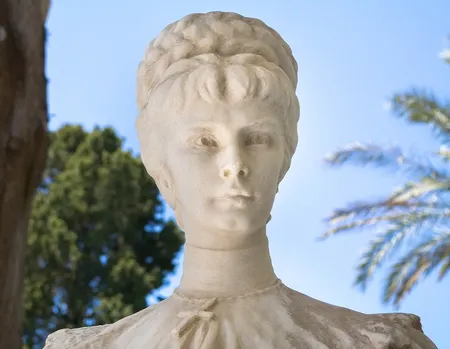
The study of shadows and lights is at the center of my creations, avoiding any direct line and thus allowing the birth of an aura of tranquility and purity.
My subjects fall into two main categories: the living and the non-living. Living things are made up of sub-categories like animals, flowers and the human body. The non-living features architectural landscapes. Apart from the living models which aim to use the technique of architectural analysis in the observation of the flesh, my works have the common point of recreating a real memory. I work from charcoal sketches in the wild and also from photos taken to complete the workshop work. I try to revive the moment to the public through the enhancement of the memorable characteristics of the mental image. The dry line thus loses its meaning at the expense of the values created by the effect of light. I thus transmit the soul of lived experience by the fuzzy, this being largely dependent on the emotional content of the experiences and the natural regards of attention. I put the accent especially on the reminders of positive moments impregnated with a feeling of well-being, those which allow the spectator to plunge into an observant serenity, thus allowing the intellect to give way to feeling. The painting gives off an atmosphere and encourages reflection through the sensation expressed by movement, shapes and colors. Figurative art allows me to better demonstrate this duality between reality and the reconstruction of the image. The slow drying properties of oil paint force the subject to slow down memories where the colors are only a few in order to better bring out the essential elements of the scenes.
Lisa: Hi Elisabeth! Tell us a bit about yourself. When did you begin doing art and how did you get started? When you were a kid, what did you want to be when you grew up?
Élisabeth: When I was growing up, we had a cottage on a lake in the Eastern Townships. In August, when the sun would surround us with its warm rays, I would take dry pastels from I don’t know where and draw the lake with its blue water and the setting sun stretching quietly along the horizon. I would draw the clouds too and I would tell myself that this landscape spoke to me of something indefinable, something that has no name and that exudes a mysterious and sacred inner essence. In those early years, I was taking classical ballet classes. I wanted to become a ballet dancer or a trapeze artist. I could see myself flying up on the trapeze and dancing with the stars. And then I had an aunt who was a painter, who taught visual arts and who was religious. We used to visit her on Sundays and she would invite us to her studio. I still remember the smell of oil paint floating all around her canvases and easels. She used to give classes in her studio. She spoke about her paintings with passion and sensitivity. I was fascinated by her speech. A few years later, I found myself in college studying visual arts. But I didn’t pursue these studies, I went on a trip. When I came back, I worked in different fields. It wasn’t until I was about 26 years old that I first returned to observational drawing and then more seriously to university studies at Concordia University where I completed an undergraduate degree in visual arts.
Lisa: What artists of the past or present have inspired you?
Élisabeth: On the one hand, there are the artists who are close to me because they have the same nationality and lived in the same century. On the other hand, there are the others, among whom it is very difficult for me to make a choice. To situate the other artists in time, we could say that they lived between 1600 and 1980. Closer to me is Jean-Paul Riopelle (1923-2002). Despite his participation in the Automatist movement and the Refus global, he retains his reference to nature throughout his work. Jean-Paul Lemieux (1904-1990), for his part, has always remained faithful to figuration despite the rise of abstract movements. His paintings, both his portraits and his landscapes, offer the eye a stripping of all the beauty of the soul. René Richard (1895-1982), a trapper and coureur des bois in northern Alberta, records his hikes in hundreds of drawings. One can feel the artists purity and authenticity in the face of the nature he admires and encounters every day. Stanley Cosgrove (1911- 2002), whose economy of means, simplified forms and limited palette are evident. In this perspective as a painter, I also seek to use a limited palette. I still remain in figurative art despite the pressure for abstract art. I seek a stripping of my subject in order to better express the soul that emerges from it.
The artists of the past who inspire me will possess similar traits. Rembrandt (1606- 1669) and Vermeer (1632-1675) for the use of light and darkness through the chiaroscuro technique and for the humanity that emerges from their characters. William Turner (1775-1851), a painter-reporter of the 19th century, who succeeded in dissolving the details of his subjects in coloured atmospheres from which emerges an aura of mystery and sublimity through diffuse light effects. Paul Cézanne (1839-1906) this impressionist painter about whom Kandinsky wrote: “He knew how to turn a cup of tea into a creature endowed with a soul, or more precisely how to recognise a being in that cup. He treated these objects in the same way as man, for he had the gift of seeing the inner life everywhere.”, Paul Gauguin (1848-1903), for his part, explores the spiritual side, the emotion, the feeling. He also appreciated the simplification of form. He does not want to copy nature but rather to dream the scene in order to induce a particular feeling in the spectator. I can’t pass by Vincent Van Gogh (1853-1890), considered today by some as one of the greatest artists of all time. He lived in misery and despair, painting and drawing having become his only reason for living. He said he wanted to paint men and women with that eternal je ne sais quoi. Finally, Marc Chagall (1887- 1985), this artist who can be attached neither to a movement nor to a school and who expresses himself through a dreamlike style full of symbols. He uses color in a very personal way and does not try to translate reality but rather the world of the unconscious.
Lisa: What motivates you as an artist? Is it curiosity, the search for beauty or meaning?
Élisabeth: First and foremost, what motivates me as a painter is the need to express my vision of the world, my perception of the beauty, invisible and spiritual presence of objects as well as human beings. Then of course, I direct my work towards an harmony of forms and meaning. Both are equally important, because both form and meaning are part of the writing of the subject. It is not curiosity that pushed me towards the creation of pictorial works and towards all this artistic approach that I have been pursuing for so many years, but rather the inner need to give meaning to my visions or my vision of the world. To give life to a work is also for me to join the presence underlying all creation, this presence which is expressed by the soul perceived as much in human beings as in objects. I aspire to express the soul. I work in the same sense as all those artists whom I admire and who influence me: like Paul Cézanne, who knew how to turn a cup of tea into a creature endowed with a soul, like Paul Gauguin who sought the spiritual side and the feeling in the work, like Van Gogh who said he wanted to paint men and women with that je ne sais quoi of eternity. Of course, I don’t compare myself to these masters of painting, I only aspire to follow their lines. In my opinion, we human beings are tenants on this planet. I therefore seek to establish a link, through the pictorial work, with the creative owner of life and the forms that are born and die on it.

Lisa: You’ve participated in an online gallery in Montréal on the theme of “Injustice” (Death of George Floyd). Could you tell us a bit more about that?
Élisabeth: Indeed, I responded to a call for submissions from an online gallery based in Montreal (www.gallea.ca). This gallery decided, following the tragic death of Georges Floyd, to propose a virtual exhibition on the theme of injustice. This tragic event challenged me, upset me and the tears rose in spite of myself. Why so much injustice in this world? Why do men kill other men? What right do they have to take their lives? As a visual artist, I thought of creating a work that denounces this injustice that has existed for too long. So here is the full text that I published in connection with the work:
“In Zanzibar"”. This drawing represents a reality in a very brutal way by which I wish to denounce the racism still rooted in our civilizations. Shocked by the violence of 2020, I created this charcoal drawing representing a blatant violence to honor the memory of those who have suffered too much, in chains, and who are still suffering. I was inspired by the “Slave Monument” located in Stone Town on the island of Zanzibar in Tanzania on the African continent. This work was erected by the Swedish artist Clara Sornas in 1998 as a reminder of the slavery that took place on this island for many years in the mid-19th century. The KKK garment, a symbol of the post-abolition racism of slavery, is placed in the foreground to remind us that the fight against racism is still going on.
Lisa: What’s the most challenging part of your artistic process? And how do you overcome it?
Élisabeth: Obviously, there are many different styles of artistic approaches. Therefore, all kinds of difficulties are inherent to each. But in my opinion, there are two main ways of drawing: either one enters into a creative process with the aim of making a production for decoration, pure and simple entertainment, in search of beauty as well as ugliness, or rather one tries to get in touch with that inner space, through which inspiration will come, that moment of grace that fills the artist and makes him happy.

Personally, I aspire to remain in the second process, the one that creates an alliance between inspiration and consciousness. For me, art addresses the consciousness of being. But it seems that it is not always easy to create by being a kind of channel for this universal place, this inner space. To answer the question about the most difficult aspect of my artistic approach, I would say that creating by staying in contact with this place that transcends us would be one of the first objectives for me. It’s a bit like saying that art gives meaning to my life. Drawing, recreating, retranscribing what the soul felt in those moments when it was in contact with the universal spirit, gives me the impression, as an artist, of making visible something that wants to be seen, that comes from elsewhere or from the other dimension. Awakening the consciousness of the spectator remains a priority in the expression of my art. Whether it is the awareness of a fact that connects him to his intellect, or an emotion that connects him to his feeling, or a sudden perception that puts him in contact with his intuition, or a physical reaction that puts him in contact with his sensory world.
On the other hand, if remaining in this state of receptivity as an artist can become a difficulty in the process, it is useful to find ways to overcome what could become an obstacle to creation. To achieve this result, to prevent the useless from entering my life, I have adopted a lifestyle that allows me to give all the necessary attention to my inner space. Thus by listening, by receptivity, I pay particular attention to this inner space that speaks to me, that carries so many images like a shower of stars in space containing as many symbols as archetypes.
Lisa: You say you paint what moves you, and makes you tick. Describe a real-life situation that inspired your artwork.
Élisabeth: A very recent situation, but not the only one, which I can tell really moved and upset me, is the death of Georges Floyd. This is why I created this drawing to help, through images, the understanding of this event. To make visible something called injustice. Several other subjects inspire and speak to me. Generally speaking, grandiose landscapes such as shady skies filled with color, sinuous mountains adorned with greenery are for me subjects to elaborate. My research consists in finding the body or the expression of a body that can marry with a landscape, a sky or something else. It is the juxtaposition of man in his corporality and nature that guides my work as a painter. Before the pandemic, I participated in live model sessions, which gave me the opportunity to accumulate a large quantity of drawings of bodies in order to transcribe them into a painting.
Lisa: How has your style changed or evolved over the years?
Élisabeth: 1980-2020
I started painting and drawing seriously around the year 1980. I have been painting ever since and my style has changed greatly over time and with experience. During my university studies (in the 1980s), abstract art was almost the norm. My research was an exploration of various styles and techniques. Engraving, painting, observational drawing, sculpture have been part of my daily life, with a tendency towards a figurative style. I painted several oil paintings, completely abstract, for which I received very good reviews and which I sold easily. But in the depths of my artistic soul, the forms always ended up resembling the objects of reality, the beings of reality. Even a deformed form in my pictorial imagination resembled either a human or an animal. Figurative painting also refers to objects, landscapes, flowers. All these elements are found in my paintings. I don&’t try to scrupulously reproduce reality, but rather to use my imagination to reconstruct another reality, more ethereal, more transcendental. The figurative style dominates the whole of my work with a tendency towards romanticism: I often refer to the immensity of nature and its omnipotence as did the painters of that time such as Delacroix. Chromatic nuances and light effects are at the center of my creations. I try to avoid hard lines and bright colors, in order to create an aura of tranquility and purity, close to the dreamlike world. Symbols and archetypes are alive in my pictorial imagination. They bring out their meaning and messages through the arrangement of images, sometimes superimposed in several layers. Sometimes, when certain events require it, I modify my style to move towards a narrative figuration. For example during political and social demands as it happened with my work: “In Zanzibar”.
Lisa: What memorable responses have you had to your work?
Élisabeth: We all have our brains more or less cluttered with all sorts of images constructed by our education, experiences and perceptions of reality. Some people will react to a picture with a feeling of ecstasy while others will pass by with few emotions and reactions. Different responses have appealed to me during exhibitions, studio visits, or publications on social networks.
For example, during an exhibition in Old Montreal, a man exclaimed, while looking at one of my paintings whose main subject was a flower: “Madam, you have a gift for capturing the beauty of things!”. I thought it was a beautiful compliment and I accepted it gladly, knowing that deep down inside me this vibration of the beauty of nature is heard quite often.
At another time, a friend came to my studio to see my latest work. When she saw the painting with the title “What are you doing to my planet? she expressed herself quite spontaneously by saying: “;How beautiful, she looks like an angel”! I said to myself that this was absolutely true: because when I painted it, I felt as if this figure above the sea and in the clouds was probably an angel. So I thought: it is true that angels do exist. Finally, at an opening, a woman standing in front of one of my paintings whispered softly to me: “You allow me to get in touch with the world of the unconscious, what a feeling of well-being”. I loved that comment, because it confirmed that I had succeeded. On social networks comments are more thoughtful and less spontaneous but just as true and relevant.
Lisa: What is the best way to reach people that are interested in your art?
Élisabeth: It seems that today an artist cannot simply produce works in his studio. He must also be an entrepreneurial artist. Since art is a niche market, it is necessary, by all means, to offer visibility to an artists work as a whole. This includes drawings made from live models as well as preparatory sketches for paintings and finished works. Nowadays, social networks offer us a panoply of sites and means to divulge our work, to make our work known and to find its public. But we have to work hard at it, constantly and every day.
For several years now, I have been using Instagram, publishing every weekend my observational drawings with live models and the paintings that are produced afterwards. I also have a profile on several art community sites. I have one on Facebook that I maintain as often as possible. In conjunction with all these online publications, I work on my website. I’m improving it and I’m looking for some training in order to better understand how to edit my works on the Web.
If theoretically several online publications allow for greater visibility, we must also look at the marketing side. The one where you pay in order to target your audience. Of course, galleries are also a great way to find your audience. But it is still necessary to be able to exhibit works that all represent the same style or, to put it another way, an artists work in which the paintings offer a homogeneity on the whole. Galleries offer us the possibility of a direct link between the public and the works of art and this process is always very enriching.
Lisa: Are there any upcoming shows or workshops we should know about (or canceled due to the Covid-19 situation)?
Élisabeth: Yes, certainly. In December 2019, I participated in a group exhibition in a downtown Montreal gallery on Sainte-Catherine Street. The place was very well located, on a street that becomes pedestrian all summer long. So a privileged passage for many tourists and passers-by potential buyers of paintings.
Towards the end of January 2020, I went back there to take back the unsold paintings. The gallery owner offered me to keep several paintings that would be exhibited during the summer months from June to September. She also offered outdoor exhibitions, as the street was pedestrian all summer long. Unfortunately, because of the Covid-19, everything was cancelled.
I also mentioned earlier the live model workshops that I attended every weekend at UQAM (Université du Québec à Montréal) and whose drawings allowed me to nourish my paintings. These workshops also had to be cancelled because of the Covid-19 and we don’t know when they will resume.

Lisa: What’s next on the horizon for you?
Élisabeth: I have a lot of development projects and publications of my work, the one I’ve done more recently as well as the work I did earlier in the 80s. Because of the pandemic, many galleries have faced unprecedented challenges in recent months. But recently, some galleries are proposing to reopen and it is with great joy that I will submit my dossier. In closing this interview, I would like to add that I aspire to exhibit internationally, to reach different audiences and to open myself up to new horizons and new creative experiences.
Elisabeth Raymond
Thank You!
Follow Elisabeth :
Website