
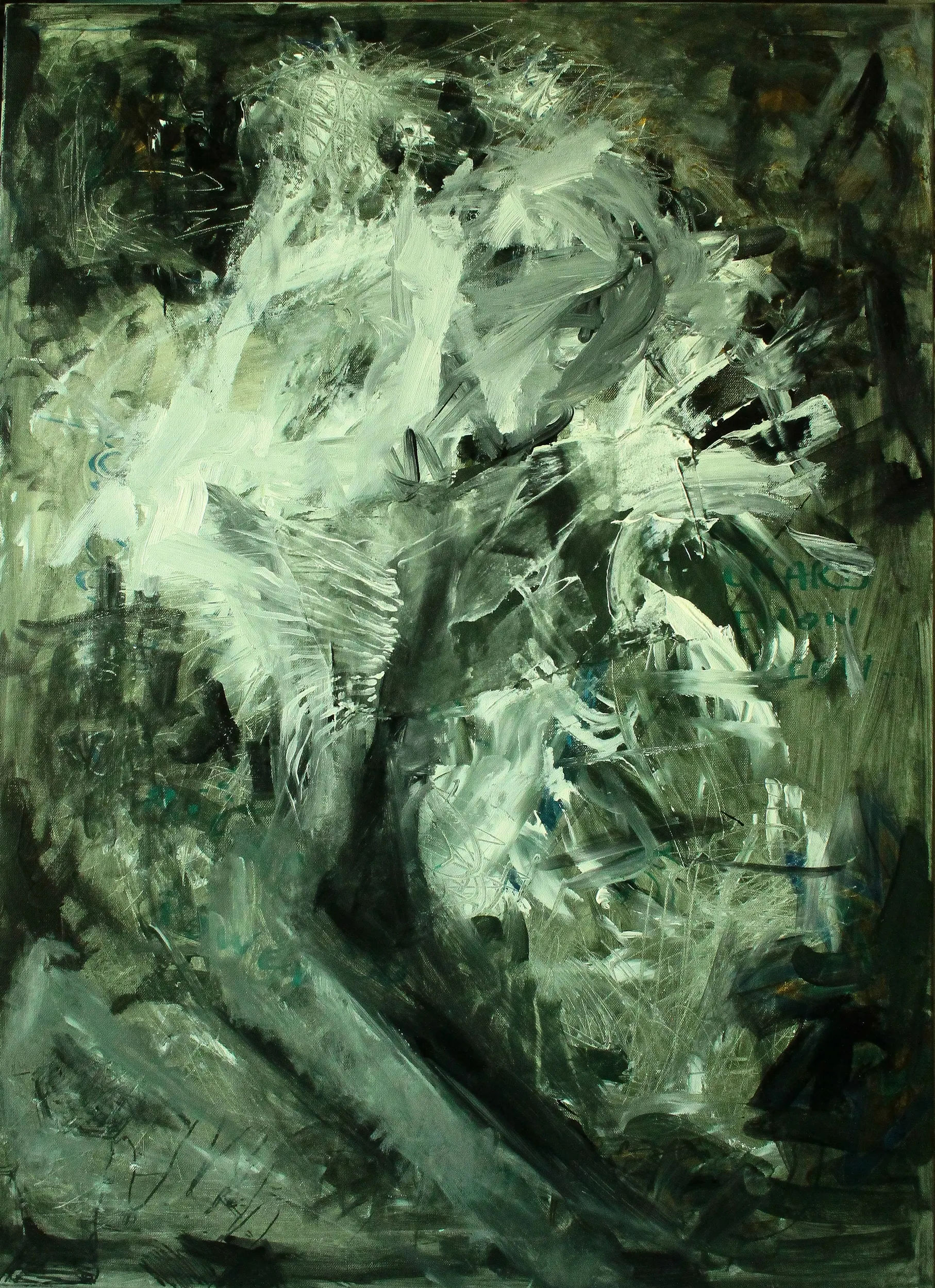
“My art is a companion on the road of inner becoming.
It was colored in pastel and vivid colors in my youth, in which I sought a certain representation of paradise, a sublimed world. After that, I searched for the transcendent in different types of religious iconography, traditional or renewed.
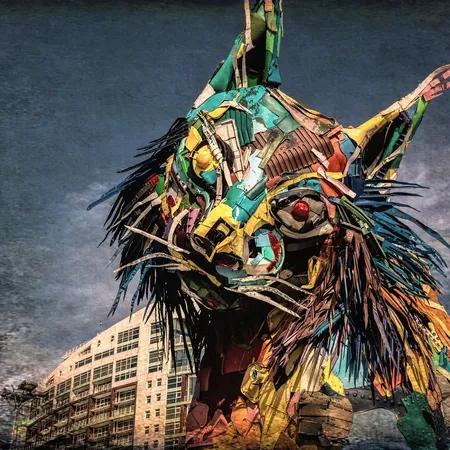 Then, going through various pictorial styles, I came to settle into an area where I’m now conceptually probing.
For the moment, I practice a chromatic ascesis, one that would lower my search into severe, harsh registers, where I would find dogmas, primordial truths, the bottom of the depths.
Metaphysically speaking, one could find there the sphere of suffering that leads man, alone, to the truth, limit, death, eternity.
I explore various rifts: the psychological transformation in times of collapse, the already existing narratives of universal culture, or the search by symbols that are often elements of nature.
Sometimes I get carried away by realistic explorations that appear almost by themselves. In an almost involuntary self-psychoanalysis.
Sometimes I use abstract languages to create agglomerations (for example) that create the expression of the states I am seeking to represent. Sometimes I deform the reality. I often approximate it: just enough for a specific idea to leave its mark, to make its presence felt. I’m trying to leave inside the picture only that which can no longer be cleaned. I’m not trying any ornaments, therefore.
Obviously, the image becomes somber. And that is because it is not about a pleasant life that calls you to live. But it is especially about those parts of it that are the hardest. The ones that we usually hide. Those parts in which we are asking questions. In which we are actually coming out of it to ask about the surroundings. See it from outside.
It’s the research I’m carrying out right now.”
How long have you been creating art? Was there a defining moment that you realized a creative life was the path for you?
Magda: I have discovered this language and the need to use it from kindergarten. It’s what I always did when I had time for myself. And I thought everyone does this when they have the opportunity. I am surprised to see that people don’t have the same enthusiasm to express themselves this way. Around me, there was always a unanimous silence and suspicious immobility about making art.
Can you remember an instance when you first knew you were a creative person? What were you doing?
Magda: I have never had the notion of “creative person”. To me, all people have the same data. I hardly can think otherwise, even now. I remember, from the early years of my life, the joy I discovered in drawing aspects of my world. There, in the drawings, I was amusing myself, recreating, reliving, and remembering known things. I found a real pleasure in re-illustrating them, after I first illustrated them in my mind. This process was like a visual mind. I didn’t know that was called “creativity”. I thought we were all doing that – we re-imagine our life, for the joy of reliving it with/in our mind, of re-thinking it.

Would life be different if you didn’t act on your creativity? How?
Magda: I wouldn’t be myself any more. And then, nobody would have lived my life. I mean, bizarrely for me, certain areas of the manifestations of my inner life are called creativity. And it takes on many manifestations, conventionally categorized as “creative”. They are only faces of the same sensitivity. And that can be censored at the outside. But inside, it will create representations with the same appetite. Or else, I wouldn’t be at all.
Are you currently exploring your art career full time or part-time? If full time, what did you leave behind to pursue your art career? If part-time, what do you do in your “day job”?
Magda: I live art full time, in a dramatic way. At high costs. For authenticity purposes. Because I am too preoccupied, existentially, with things that are not suitable for most of the jobs. (And this is done in parallel with the management of my inner being. With serious lessons that make it filter constructively.)
How has your work developed since you began and how do you see it evolving in the future?
Magda: I started from studying and understanding realism, which is fascinating as well. Then I changed realism, leading the image in various directions: toward impressionism, expressionism, abstract, etc. I changed the objects using all sorts of filters or by synthesizing them geometrically. I also approached the Byzantine iconography (older or newer), where I looked for identical filters that were essentializing through hyeratism, geometrical, or not. I sublimated the color palette (using light colors, subtle tones, and arrangements) and then I make it subject to a true asceticism, reducing it to black and white. I have also practiced an intuitive abstraction, which has brought me to the lately attempt to paint my vision of life, as I understand it. To paint my own world. And I am interested in the deep areas of it, where the severe, immutable, simple truths stand. But I haven’t comprehended it entirely yet. I see that there is a need for a deep self-awareness. A serious probing of the inner self. This is where I linger for the moment. And it seems that in all this together, there are many layers of ungenuine reading that need to be revealed, removed. For reasonable cleaning. And for the hope of truth.

What challenges have you faced in your creative work?
Magda: The biggest challenge I have to face is that the true test (applied to my work) has been always severe and intransigent. If it were passed, my work would gain the right to exist. I am a humble worker in this field, hoping I will ever bear authentic fruits. Financial problems, not fewer, are decorative compared to the first.

Where do you “find” your ideas?
Magda: I think a mind must first be populated with truths taken from the world’s treasure of experience and thought and from personal experience. It is already a great task, with which all struggle, among those willing to do so. Such a properly furnished mind, accompanied by the sensitivity of the artist and his creativity, could bring into the picture some reasonable, valid products that would not be immediately deprecated, with the first test. So my tank is anywhere: in the visual, ideas, intuition. What is being filtered out there and how is the challenge.
Can you describe your process of receiving the inspiration for your artwork?
Magda: I’m always looking for the essence of a strong idea. An idea to clean until there is nothing left to clean. For me, the image is generally a symbol of an idea. And the techniques are countless: intuitive search for elements that support an idea or a painted emotion starting from a (simple) image that is emblematic of an idea etc. More specifically, sometimes I start from an abstract image and identify a recognizable element or vice versa, I start from a realistic image and I abstract it, seeking to remove the ephemeral and to bring it into an area of eternity.

What does your creative work offer, in a larger sense, to your life?
Magda: Art is one of the manners in which I investigate the truth. In which I look for what is relevant, imperishable, admirable to human beings, and to life. It’s a tool for settling ideas. To reveal them. A tool of synthesis. It’s a very intimate language that drives my being. That gathers its powers in particular action and makes me feel its edges. It’s cathartic, of course, for me. I breathe, when I work, with all my being. A sort of wing that each of us uses in its own way.

How can people follow your news?
Magda: The latest works I post on Instagram:
I also have a site where I decant everything that is most representative of what I am looking for.
https://magdalazar.wixsite.com/visualart
On Saatchi there are things I sell.
https://www.saatchiart.com/mlazar